
Searching Montgomery County Criminal Dockets
Felony? Start at the Georgia Courts E-Access directory. Its Montgomery Superior Court entry routes you to PeachCourt. That platform requires an account; it is not a free anonymous statewide database. The help material documents a search by county, court, and exact case number. Without a number, call Clerk of Superior Court Tammy C. Foskey at 912-583-4401. An older case may not appear in the account view. Then visit the clerk's counter.
Magistrate Court matters go to that court directly at 912-583-2170. Its county page lists warrants, first appearances, bond hearings, preliminary hearings, ordinance matters, bad checks, and several other criminal functions. It offers no criminal docket search form, though. City ordinance and municipal traffic cases belong with the issuing city's court.
- Identify Superior, Magistrate, Probate, Juvenile, or municipal court from the notice, citation, or filing.
- For Superior Court, create or use a PeachCourt account and select Montgomery County and Superior Court.
- Enter the exact case number when available, then compare the court and case details before opening the docket.
- Read each setting and entry as a procedural event, not as proof of a result.
- Ask the responsible clerk for a public terminal view, older file, redacted copy, or certified copy when needed.
Montgomery Criminal Calendar Labels
The Oconee Judicial Circuit's published calendar adds useful local flavor. Montgomery entries carry labels like Criminal Term, Criminal Calendar, Arraignments, Pleas/Bonds, Negotiated Pleas, and motions. Each label marks a block of court work. It tells you nothing about any single case.
The Oconee Circuit calendar PDF lists dates and a Montgomery label. It also names the assigned judge and the type of setting. Party names, case numbers, charges, attorneys, document links, and dispositions stay off it. Treat it as a schedule guide. Then confirm the current setting against the case docket and the clerk, since circuit dates shift.
- Arraignment
- The proceeding at which the accused is formally called to answer the charge.
- Pleas/Bonds
- A calendar block for plea or bond matters, not a statement that a plea was entered or bond was granted.
- Criminal Term
- A block of Superior Court work assigned to Montgomery County over listed dates.
- Preliminary hearing
- A Magistrate Court proceeding that is distinct from a Superior Court felony trial.
Inside a Montgomery County Criminal Docket
Think of a public criminal docket as an index of court activity. The unauthenticated PeachCourt pages do not expose the exact labels on a live Montgomery case. So confirm some fields after login. Record the useful points: court, exact case number, filing date, charge label, settings, judge, disposition display, and document availability. A charge or an open setting never proves guilt.
| Case Number | The court's identifier; Montgomery's criminal format was not published, so do not assume a sample such as YYYY-CR-##### is local. |
|---|---|
| Charge | The filed charge label, which is an allegation unless and until the docket records a disposition. |
| Settings | Arraignment, bond, plea, motion, criminal calendar, trial, or another scheduled event. |
| Entries | Filings, motions, orders, notices, continuances, pleas, judgments, and appeal activity when public. |
| Disposition | The result displayed by the court, if available; confirm the wording and related order in the official file. |
| Documents | Eligible file-stamped images may be account-gated or unavailable because of age, court, or access restrictions. |
Montgomery Felonies and Magistrate Hearings
Within the Oconee Judicial Circuit, Superior Court of Montgomery County serves as the venue for felony and serious criminal trials. Magistrate Court plays a different part. It runs warrants, first appearances, bond hearings six days a week, preliminary hearings, civilian warrant applications, and certain limited misdemeanor or ordinance matters. One incident can therefore leave entries in several courts as it moves along.
| Route | Typical Montgomery work | Access point |
|---|---|---|
| Superior Court | Felony prosecution, arraignment, motions, pleas, trial, and disposition | PeachCourt account, public terminal, or Superior Clerk |
| Magistrate Court | Warrants, first appearance, bond, and preliminary hearing | Magistrate Court counter or 912-583-2170 |
| Municipal court | City ordinance, traffic, and limited municipal matters | Issuing city court or official municipal directory |
A first appearance or preliminary hearing is not a felony trial. Nor does a Magistrate warrant record replace the later Superior Court docket. When a case crosses courts, search each one responsible.
How a Montgomery Criminal Case Moves
Dockets grow as cases advance, and routes vary. Early warrant, first-appearance, and bond work may start in Magistrate Court. A felony then moves to Superior Court. There the docket can record charging documents, arraignment, motions, scheduled calendars, plea or trial activity, disposition, and sentencing. The Montgomery County Public Defender page covers indigent-defense service in Superior and Magistrate matters and sometimes Juvenile Court. It is a route to representation, not a docket search. A reset moves a date; it never dismisses the case.
Docket flow: Filing › Arraignment › Pretrial › Plea or Trial › Disposition › Sentencing
On the Oconee calendar, "Negotiated Pleas" labels a block of cases set for one session. It is not an outcome for every case listed there. Open the individual Montgomery County criminal docket and read the filed plea or order before calling any result.
Montgomery Criminal Records Go Digital
Georgia's court technology remains spread across local clerks and approved vendors. The e-file directory marks Montgomery Superior Court as mandatory on PeachCourt, and the state is also building its statewide Gavel case-management project. Even so, modernization has not merged every local criminal file into one public database.
The Georgia Courts case-management project lays out the broader technology direction. That official page helps separate statewide infrastructure from the current Montgomery County criminal docket access routes.
Whatever the project delivers, today's searcher still needs PeachCourt plus the court-specific clerk routes for Montgomery County.
Courts That Hold Criminal Dockets
Jurisdiction decides who holds the record. Tammy C. Foskey, Clerk of Superior Court, maintains the Superior criminal record. Montgomery Magistrate Court keeps its warrant, bond, preliminary-hearing, and limited lower-court files. Probate Court holds its own misdemeanor traffic and game or fish citation records. Juvenile Court records sit under stricter access law. Each municipal court keeps its own city docket.
The official Oconee Circuit directory places Montgomery County in the circuit. It also urges users to verify calendar dates. That directory page supplies the local court context.
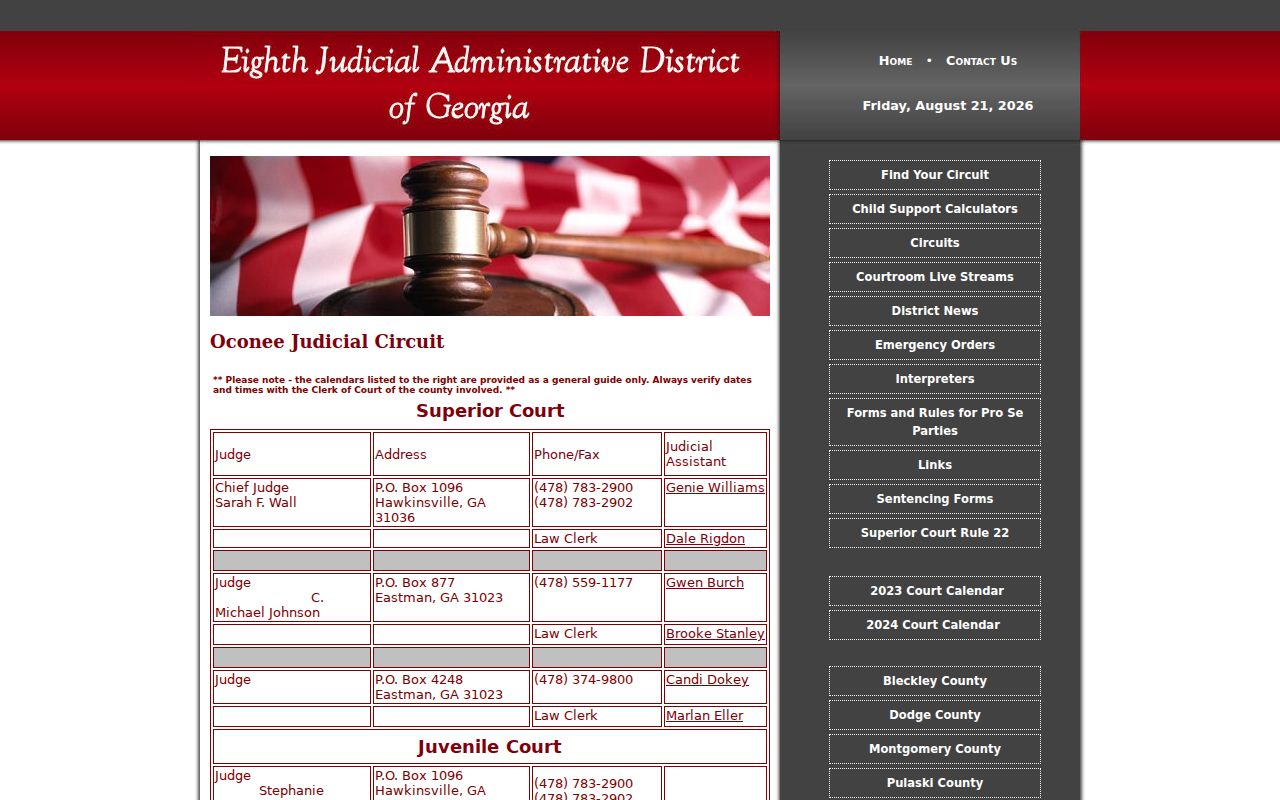
Use the circuit source to spot Superior Court scheduling. The docket and its documents stay with the clerk or an authorized system.
When a Montgomery Criminal Case Is Missing
A blank PeachCourt screen proves nothing. The case number might be typed wrong, or you may be searching the wrong court. Some older files were never digitized. Matters can sit in Magistrate, Probate, Juvenile, or a municipal court instead. Sealed or excluded records are also kept out of online document access. An empty result never rules out a case.
- Confirm the county, court class, and exact case number from an official notice.
- Use PeachCourt's missing-case route if the Superior case should appear behind the account.
- Ask the Superior Clerk about a public terminal or older paper file.
- Call Magistrate Court for its own proceedings, or contact the issuing city for a municipal matter.
Want a fuller walkthrough on searching by case number? Use the Montgomery County case lookup once that page is up.
Sealed Dockets and Public Access
Georgia treats court records as public, though only up to a point. Uniform Superior Court Rule 21 lets a judge restrict access. But it takes a written order, legal support, and the required balancing first. Sensitive identifiers get separate treatment under Rule 21.6. Juvenile records face tighter limits. PeachCourt blocks sealed matters, adoptions, and proposed unexecuted orders from document access altogether.
Key access rules:
Uniform Superior Court Rule 21 starts with public access while allowing a properly supported limit.
Georgia Open Records guidance directs a request to the correct records custodian and calls for an exemption to be identified when access is denied.
Juvenile records under O.C.G.A. §§15-11-708 and 15-11-709 are not ordinary public criminal dockets.
So ask for the public docket-only view, a redacted copy, or the sealing order itself. A broad request cannot beat a statute or court order. When an image is missing, that may simply be a lawful access line rather than a failed docket search.