
Searching the Montgomery County Court Docket
Figure out which court holds the case before you type a name anywhere. Georgia's Georgia Courts E-Access directory sends Montgomery Superior Court searchers to PeachCourt. PeachCourt needs an account. Its public help material walks through searching Cases by county, court, and exact case number. So there is no free anonymous statewide database behind it. For a Superior civil or felony matter, you can also call Clerk of Superior Court Tammy C. Foskey at 912-583-4401. You can also ask about the free public terminal that PeachCourt says clerks may provide.
The lower courts keep their own Montgomery County court records. Magistrate Court handles civil claims, warrants, bonds, and preliminary hearings. Probate Court holds estates, guardianships, and licenses. It also keeps vital records and certain traffic matters. City ordinance and traffic dockets stay with the municipal courts. When a case is not in Superior Court, search each of these offices separately.
- Read the citation, pleading, notice, or case paper and identify the named court.
- For Superior Court, use Georgia E-Access to reach PeachCourt, then choose Montgomery County and the correct court.
- Enter the exact case number when available and verify the court and caption before opening the result.
- If the record is absent, use the responsible clerk's phone, counter, public terminal, or written-request route.
- Confirm a setting, disposition, or certified copy with the court that holds the original file.
Montgomery County Court Docket Route Through PeachCourt
For Superior Court of Montgomery County, Georgia, PeachCourt is the practical online door. The state e-file directory also lists Montgomery Superior as mandatory on PeachCourt. Note the split, though. Public searching and attorney e-filing are related vendor functions. They are not the same thing. The public side needs an account. The E-Access page simply points to the chosen provider.
| Confirmed control | Purpose | Montgomery limit |
|---|---|---|
| County | Select the county whose case is sought | Choose Montgomery County |
| Court | Narrow the provider search to a court | Superior is documented; lower courts use their own offices |
| Exact case number | Locate a case in the Cases search | The local number format was not published |
| Exact Peach number | Locate a filing in the filing search | It is not a party-name substitute |
What if a case should be in PeachCourt but nothing comes back? Its help system offers a missing-case route. It is built on the account email plus county, court, case number, or a docket URL. Treat a blank result as a reason to check the route. It is not proof that the case never existed.
Inside a Montgomery County Court Docket
Think of a docket as an index of case activity. One page may gather the case number and filing date. It may also list court, judge, case type, caption, parties, attorneys, settings, disposition, and entries for filings or orders. PeachCourt sits behind an account. So confirm exact field labels and status terms after login. Do not assume financial details or document images are complete.
| Case identity | Court, case number, caption or style, case type, and filing date when displayed. |
|---|---|
| Parties and counsel | Plaintiff or petitioner, defendant or respondent, and representation when public. |
| Docket entries | Complaint, petition, answer, motion, notice, order, continuance, judgment, disposition, or appeal activity. |
| Settings | Date, judge, setting type, courtroom, and reset history when the system provides them. |
| Documents | Eligible file-stamped images may be purchased by account holders; restrictions and digitization gaps apply. |
| Access limits | Sealed, adoption, proposed unexecuted-order, juvenile, and sensitive material may be excluded or redacted. |
A docket entry is not always the document behind it. A downloaded image is not a certified copy, and a complaint is not a judgment. Read the whole sequence of entries, then ask the clerk when the legal effect is unclear.
Montgomery County Court Docket Behind the 1907 Courthouse
Montgomery County dates to 1793, and Mount Vernon became the county seat in 1813. The Digital Library of Georgia courthouse record identifies the courthouse completed in 1907. It was rehabilitated in 1991 and 1992. That history has a practical effect. It explains why local access still pairs electronic records with older paper and minute-book holdings. The courthouse record predates PeachCourt by generations.
Probate Court says its filings are entered in permanent minute books. The Superior Clerk also maintains court, real-estate, UCC, notary, jury, and related records. For older Montgomery County court docket material, ask the responsible office. Ask whether the file is paper, scanned, or available through a public terminal. Do not assume milestones the offices do not publish. That includes a courthouse fire or a first online search. Note: The dated footer on the legacy clerk website proves nothing. It does not show when Montgomery County first offered online docket access.
Courts That Keep Dockets in Montgomery County
Start with the county's own Montgomery County courts page, which lists the courthouse address and routes readers to each local court office. Montgomery County divides its records by jurisdiction. Superior Court has broad trial jurisdiction over felonies, divorce, title and equity disputes, and major civil cases; the Oconee Judicial Circuit overview explains that circuit assignment and Superior jurisdiction. Magistrate Court handles money claims up to $15,000. It also covers dispossessory and garnishment cases, warrants, bonds, preliminary hearings, and certain ordinance matters. Probate Court covers estates, guardianships, licenses, vital records, and misdemeanor traffic or game and fish citations. Municipal courts keep city traffic and ordinance dockets. Juvenile Court records follow stricter access rules.
For the wider frame, the Georgia court structure resource describes the state's trial-court classes and the statewide jurisdiction context behind every Montgomery County court docket.
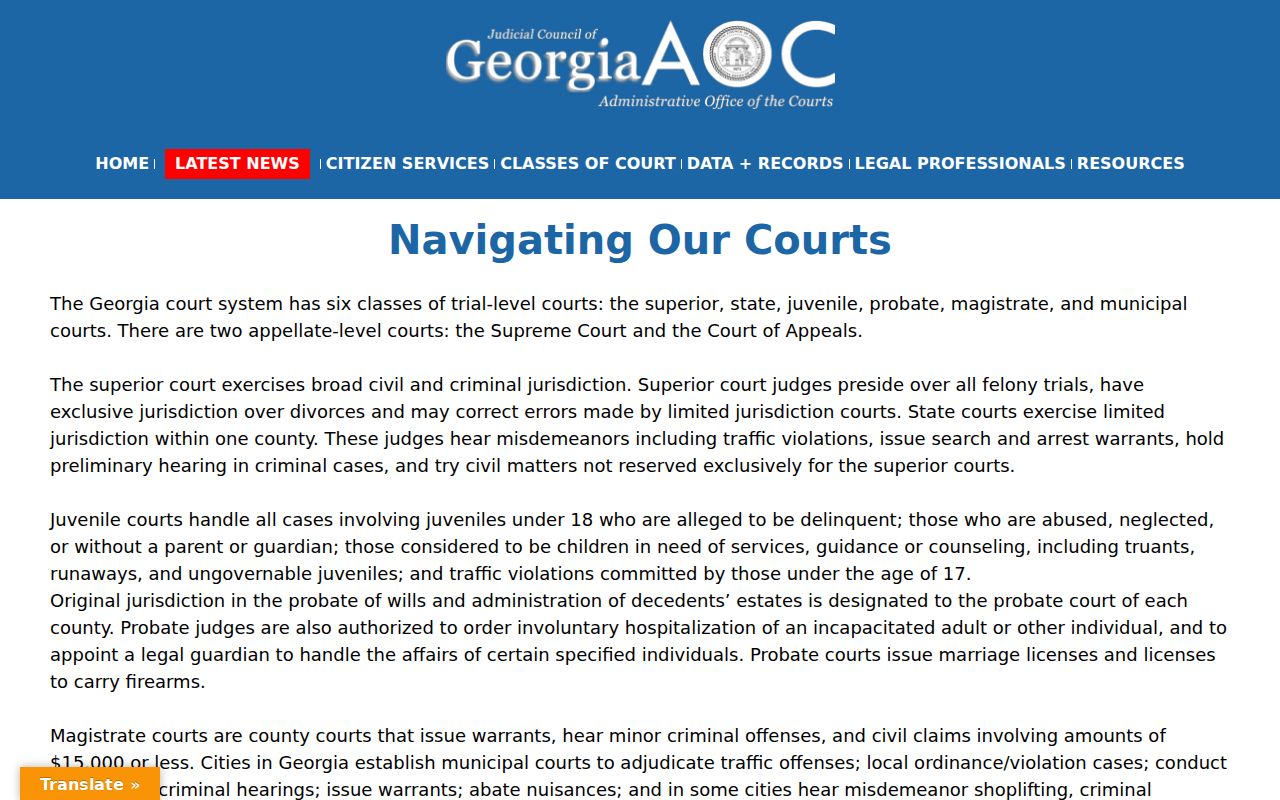
The court class decides both what the docket covers and which clerk or vendor can hand it over.
| Court | Docket covers | Where to search |
|---|---|---|
| Superior Court | Felony criminal, divorce, equity, title, and major civil cases | PeachCourt account, public terminal, or Superior Clerk |
| Magistrate Court | Lower civil claims, dispossessory, garnishment, warrants, bonds, and preliminary hearings | Magistrate counter or 912-583-2170 |
| Probate Court | Estates, guardianships, licenses, minute books, and certain traffic cases | Probate Clerk's office and its documented payment route |
| Municipal courts | City traffic, ordinance, and limited municipal matters | Issuing city or official municipal directory |
| Federal court | Federal civil and criminal cases | PACER, federal terminal, or Southern District clerk |
Montgomery County Court Docket at Three Lower Counters
A common search mistake is treating the county courthouse as one records counter. In practice, the Superior Clerk, the Magistrate Court administrative office, and the Probate Court Clerk's office are separate custodians. Each keeps its own files. A city court adds yet another route for municipal matters. Each office can answer only for the records it maintains.
- Superior docket
- The running record for the county's broad trial court, reached online through PeachCourt or through Tammy Foskey's office.
- Magistrate file
- The court record for lower civil claims, dispossessory matters, warrants, bonds, and preliminary hearings.
- Probate minute book
- The permanent record route for probate filings, subject to the restrictions that apply to the matter.
- Municipal docket
- A city court's traffic, ordinance, or other limited case record, not a PeachCourt Superior result.
Land and UCC indexes held by the Superior Clerk are separate from a lawsuit docket too. Choose the record type as carefully as the courthouse office.
How to Find Court Dates and Settings
Start with the case docket. Start with the clerk who keeps it, too. Do that before you rely on any hearing date. The Oconee Judicial Circuit puts out a PDF calendar. It covers Montgomery criminal terms, arraignments, pleas or bonds, negotiated pleas, motions, and other settings. Those labels name blocks of scheduled work. They do not report outcomes. The circuit directory itself warns that calendar dates should be verified.
Montgomery County's general calendar works as an event search with date and department controls. It is not a case calendar. The legacy clerk calendar shows a heading but no current entries. For Superior settings, check PeachCourt and the clerk. For Magistrate, Probate, or municipal settings, contact that court directly. Mount Vernon separately lists a municipal calendar event on the third Tuesday at 4 p.m. That single event is not a full case register.
A calendar is a scheduling guide. A reset can change a date, and a calendar label such as “Negotiated Pleas” does not establish what happened in a specific case.
Montgomery County Court Docket Versus Oconee Calendar
The Oconee calendar answers only a few questions. It lists the county, the date or date range, the assigned judge, the setting type, and the term category. That is where it stops. A Montgomery County court docket fills in what the calendar leaves out: the case number, the caption, the parties, the attorney, the charge, the status, the disposition, the bond, and any document link.
| Source | Best use | Do not assume |
|---|---|---|
| Oconee Circuit PDF | See a term or calendar block for Montgomery County | That each listed setting produced an outcome |
| PeachCourt docket | Review Superior case entries and eligible documents | That every old or restricted image is online |
| County event calendar | Find county government events | That it lists court cases or hearings |
| Clerk confirmation | Verify the current setting and official file | That a prior PDF remains unchanged |
Older circuit calendars carry their own trap. A judge listed on one may no longer sit on the bench. The Oconee Circuit had a vacancy after Judge Howard Cauldwell Kaufold Jr.'s death, reported in a July 29, 2026 Judicial Nominating Commission notice. So before relying on any assignment, confirm it with the circuit or the clerk.
Public Access to Court Dockets
Georgia starts from openness. Both O.C.G.A. §50-18-70 and state Open Records guidance send records requests to the proper custodian. Court records get the same lean toward access. Uniform Superior Court Rule 21 opens court records to the public, though a supported limit can follow the required balancing and written-order process. Rule 21.6 and O.C.G.A. §9-11-7.1 govern sensitive identifiers. Juvenile records face tighter restrictions than the rest.
Key access authorities:
O.C.G.A. §50-18-70 and Georgia Open Records guidance support a direct written request to the correct custodian.
Uniform Superior Court Rule 21 governs Superior Court public access and supported sealing.
Rule 21.6 and O.C.G.A. §9-11-7.1 require care with sensitive identifiers in court filings.
O.C.G.A. §§15-11-708 and 15-11-709 keep juvenile law-enforcement and court records outside ordinary public searching.
Under the general state framework, an office has three business days to produce records or send a timing, cost, or exemption notice. A broad request does not beat a statute or a sealing order. When part of a file is restricted, ask for the public docket-only view, a redacted copy, or a segregable public portion.
Montgomery County Court Docket View Versus Document
Think of four different products. A free terminal view shows the docket itself. A PeachCourt docket entry lists what happened. A purchased image is the file-stamped page behind an entry. A certified copy from the clerk is the version with legal weight. Each serves a different purpose, and knowing which one you need saves money. PeachCourt prices eligible images at $0.50 per page, plus a small convenience fee. The exact convenience charge is not published. Expect gaps, too. Sealed matters, adoptions, and proposed unexecuted orders are excluded. Not every older document is online.
A docket can identify an entry without ever showing its image. Buying an image does not make it certified. Montgomery County publishes no Superior copy form or fee schedule. Call Tammy Foskey's office to ask whether an official copy exists and what it costs today. For Magistrate, Probate, or municipal material, take the request to that court. Do not send it to the Superior Clerk.
Note: Ask for plain, certified, redacted, or docket-only material by name. Then the clerk can match the right product to the right cost.
Docket Records at the Clerk's Office
Clerk of Superior Court Tammy C. Foskey is the constitutional custodian for Superior civil and felony criminal files. The same office keeps the related jury, real-estate, UCC, notary, and court records. Her current county directory listing carries the office phone and fax. The wider Montgomery County directory helps you sort out which court office to call. Reach the office at 912-583-4401. The courthouse sits at 400 South Railroad Avenue in Mount Vernon. Mail goes to P.O. Box 311, Mount Vernon, Georgia 30445. The county and a dated legacy clerk home page both confirm that address. Treat the legacy site as historical contact context only, not as a current docket search.
Clerk of Superior Court
Tammy C. Foskey
400 South Railroad Avenue
Mount Vernon, GA 30445
912-583-4401
Ask about Superior docket access, the public terminal, older files, copies, certification, and any access restriction.
A written request works best when it is specific. Give the court, the case number, a date range, the record type, your preferred format, and contact information. Ask for a cost estimate up front. Request that any withheld portion be tied to a stated exemption or order. Keep a Superior request away from Magistrate, Probate, or city files. Those belong to their own courts.
When a Montgomery County Court Docket Is Missing
A missing online result does not mean the case does not exist. The case number may be wrong. You may have selected the wrong court, or the file may predate the images now available. Sometimes the matter sits in a lower court entirely. And a sealed or excluded document can leave a visible docket reference. Its image stays out of view.
- Confirm the court and exact case number from an official paper.
- For Superior Court, recheck Montgomery County and Superior Court in PeachCourt.
- Use PeachCourt's missing-case form when a Superior case should be present.
- Ask Tammy Foskey's office about the public terminal or an older paper file.
- Contact Magistrate, Probate, Juvenile, or the issuing city when jurisdiction points elsewhere.
A blank search screen tells you almost nothing on its own. It does not prove a person has no Montgomery County case, and it does not mean any filing was dismissed or that some record is public. The clerk can sort out the difference between a search that failed and a record the law keeps closed, so ask before drawing conclusions from an empty docket result.
Montgomery County Court Dockets by City
The five city pages below track the five largest incorporated places in the official 2020 Census table for Montgomery County. Keep municipal dockets and county Superior records apart; they are separate systems. Mount Vernon posts its city access details. The smaller towns usually mean turning to the Georgia Municipal Courts Directory. From there, call the issuing court itself. Size and population rank never decide who has jurisdiction over a case.
Mount Vernon Docket Search
County seat and largest city, population 1,990 in 2020. City Hall links JusticeONE, and Municipal Court appears on the third Tuesday at 4 p.m.
Ailey Docket Search
Population 519 in 2020. No current local portal was found, so begin with the official municipal directory and issuing court.
Uvalda Docket Search
Population 439 in 2020. Its state charter authorizes a municipal court but does not provide a current docket portal.
Higgston Docket Search
Population 314 in 2020. Confirm the municipal record route and setting directly when no city search is published.
Alston Docket Search
Population 178 in 2020. An absent city portal does not transfer a municipal case into PeachCourt or Probate Court.
Montgomery County Court Docket in a Rural System
Montgomery County runs small. It holds six incorporated places, one circuit-wide calendar, and a historic courthouse. A statewide-approved private vendor handles its records. DCA planning material put the 2019 population at 9,172 people spread over 239.5 square miles. Those numbers describe how rural the county is. They do not measure how full its court docket happens to be.
Georgia's Research and Data Office publishes dashboards for court classes. The counts, it warns, are self-reported. They are not individual case records. No Montgomery County filing totals sit on those dashboards. The office shares no pending caseload or clearance-rate table either. County budgets tell you what the courts spend, not how many cases were filed. The FY2024 judicial total, in short, is a spending figure. It must not be read as a case count for the Montgomery County court docket.
Map and Directions to the Montgomery County Courthouse
Superior Court's felony criminal and broad civil files are kept at the Montgomery County Courthouse, 400 South Railroad Avenue in Mount Vernon, the county's 1907 courthouse building that was rehabilitated in 1991-92. Probate Court's estate, guardianship, licensing, and vital-records office is also reached through the same courthouse address. Clerk of Superior Court Tammy C. Foskey's office is the constitutional custodian for the Superior docket kept there.
Clerk of Superior Court
Tammy C. Foskey
400 South Railroad Avenue
Mount Vernon, GA 30445
912-583-4401
The legacy clerk site routes mail to P.O. Box 311 rather than the street address, and the county's own footer separately lists a 310 West Broad Street contact, so confirm the correct counter before a filing or records trip. Parking, security-screening, and accessibility details for the courthouse are not published; calling ahead is worthwhile.